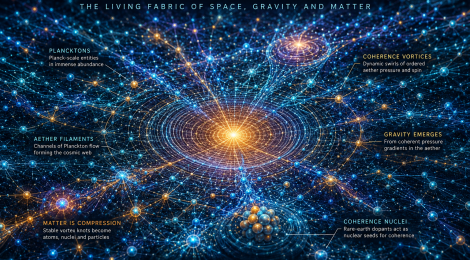
The Universe As An Atom-Ecology Populated By Plancktons
The Universe As An Ecosystem, Atom-Ecology
Introducing a New Working Paper on My GAC5D Model, Plancktons, and Cold Fusion
For more than three decades, I have worked directly with some of the strangest experimental phenomena in modern science. My work has been mostly in my own labs, but I have also frequently worked as a visiting scientist with and at top national nuclear laboratories in the USA, Europe, and Asia.
Not theories.
Not simulations.
Not thought experiments.
Actual laboratory systems that repeatedly produced observations which conventional physics could not comfortably explain.
These included:
- anomalous excess heat,
- helium isotope 3He and 4He production correlated with heat,
- isotope ratio shifts,
- high Z transmutation signatures,
- unusual and yet prescribable low-energy gamma emissions,
- and dramatic magnetic-field-sensitive nuclear effects.
Over time, these experiments led me into a line of thinking very different from the conventional narratives surrounding both gravity and nuclear physics.
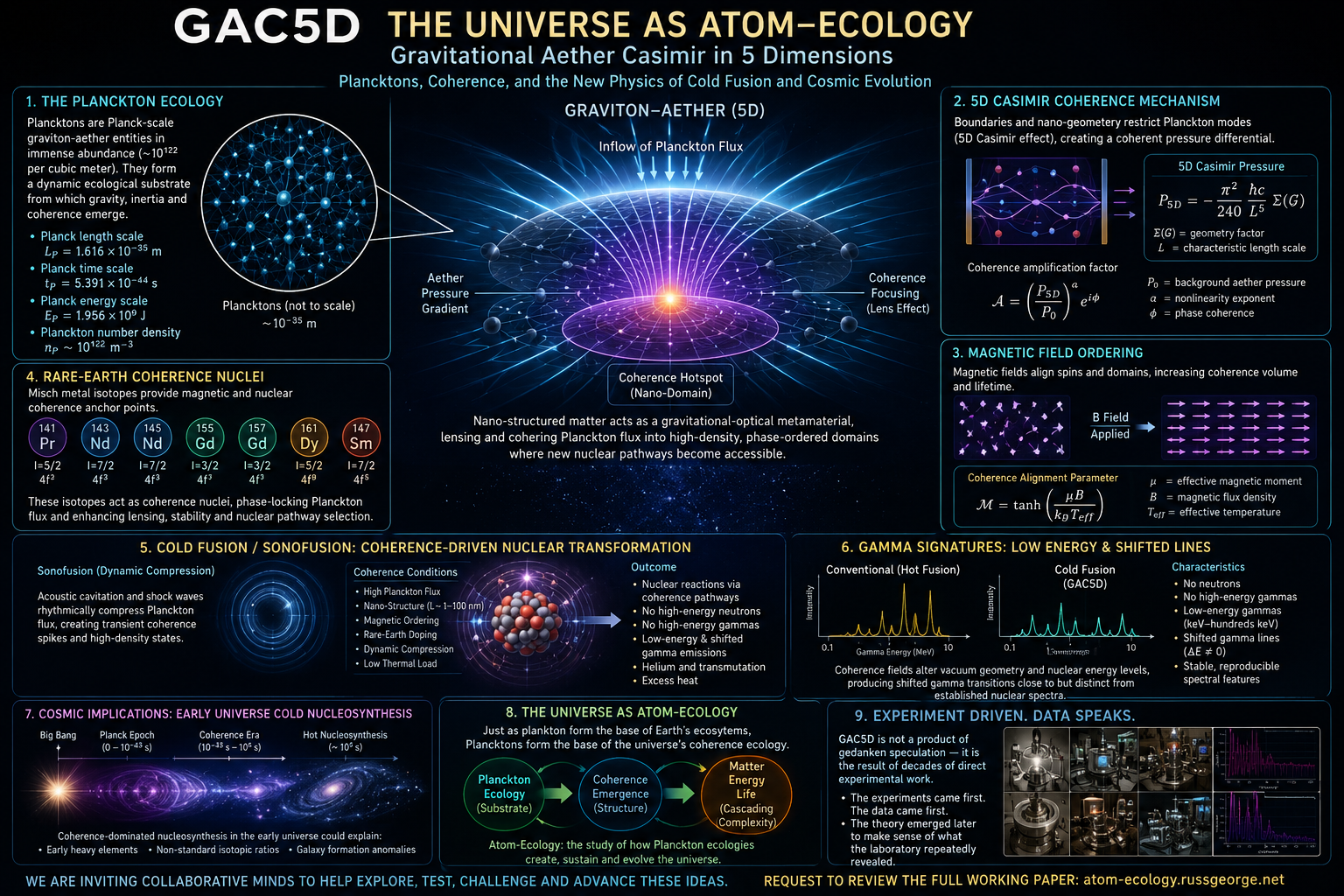
The result is what I now call the GAC5D framework — Gravitational Aether Casimir in Five Dimensions.
Today, I am announcing a new long-form working paper exploring some of the deeper implications of this framework, especially as they relate to:
- cold fusion,
- sonofusion,
- nanoscale coherence,
- graviton-aether dynamics,
- and the possibility that the early universe itself underwent forms of “cold nucleosynthesis” before the first stars were born.
This is not a polished final paper.
It is intentionally exploratory.
It is a thinking draft.
And I believe some of the ideas inside it may be among the most important I have yet attempted to organize.
From Cold Fusion to Cosmology
One of the central motivations for this work is the growing realization that the anomalies appearing in condensed matter nuclear experiments are not isolated laboratory curiosities.
Increasingly, modern astrophysical observations are beginning to show similarly uncomfortable anomalies.
The James Webb Space Telescope (JWST), Gaia, and other new observational systems are revealing:
- galaxies rotating too fast,
- wide binary stars accelerating beyond Newtonian expectations,
- stars appearing “too mature too early,”
- unexpected heavy elements in the young universe,
- and isotopic ratios that strain conventional cosmological nucleosynthesis models.
At the same time, cold fusion experiments have continued to exhibit an equally stubborn collection of anomalies:
- immense helium production without neutrons,
- kilojoule heat production without expected radiation,
- low-energy gamma emissions,
- shifted gamma lines,
- and dramatic sensitivity to magnetic fields and nano-structure.
My growing suspicion has become this:
These are not separate mysteries.
They may be fragments of the same deeper vacuum physics.
The Planckton Idea
One of the central conceptual tools introduced in this working paper is the idea of Plancktons.
The name is intentional.
These are hypothesized graviton-aether entities existing near Planck-scale dimensions while also existing in immense abundance throughout the vacuum.
The analogy is ecological.
Just as ocean plankton form the microscopic substrate supporting Earth’s marine ecosystems, Plancktons are proposed as the ultra-dense microscopic substrate from which gravity, inertia, coherence, and matter organization emerge.
This ecological intuition has led me to describe this entire line of thinking as:
Atom-Ecology
The universe may behave less like a static machine and more like a coherence ecology.
Under this interpretation:
- gravity becomes an emergent pressure ecology,
- matter becomes organized coherence,
- and fusion becomes a vacuum-structuring phenomenon.
Cold Fusion as Gravity Optics
One of the most provocative ideas explored in the paper is the possibility that active cold fusion materials function as nanoscale gravitational-optical metamaterials.
In conventional physics, lenses focus light.
In GAC5D, structured nano-domains may focus graviton-aether coherence.
The fuel materials used in cold fusion systems are not simple solids. They contain:
- cracks,
- grain boundaries,
- hydride domains,
- voids,
- magnetic inclusions,
- plasmonic structures,
- and nanoscale Casimir-like cavities.
I now suspect these structures may collectively act as a distributed coherence lens array for the local graviton-aether field.
Given our context is at the scale of the Planck length, if a Planckton were the size of a grain of sand, a nanometer would be bigger than a planet. The scale is so extreme because the Planck length is around e meters, while a nanometer is e meters. With such parameters, our nano-scale lens becomes very significant.
This may explain why cold fusion systems are so extraordinarily sensitive to:
- nano-structure,
- magnetic fields,
- loading history,
- and rare-earth dopants.
It also offers clues as to why these systems repeatedly suppress the expected abundant and energetic neutron and MeV gamma signatures expected from conventional hot fusion.
Instead, the experiments often produce:
- low-energy gammas,
- shifted gamma lines,
- helium production,
- and long-lived coherent active states.
The data increasingly appears to be describing a coherence-driven process rather than a thermal collision-driven process.
Why This Matters
I want to emphasize something very important.
This framework did not emerge from sitting in an armchair trying to imagine and invent an exotic cosmology.
For me, the experiments came first and remain first and foremost.
Data must always speak first.
The theory emerged later as an attempt to organize what the laboratory repeatedly appeared to be saying.
That distinction matters.
Much of modern theoretical physics has become highly mathematical but increasingly disconnected from direct experimental anomalies.
My own path has been the opposite.
I have spent decades working directly with systems that consistently refused to obey our expectations.
At some point one must either dismiss the anomalies or begin listening to them.
This paper is part of my attempt to listen.
An Invitation to Reviewers
The working paper I am now making available to those who might want to collaborate is intentionally unfinished.
It is not intended as a final polished publication.
Instead, I hope it can function as a catalyst for discussion, criticism, simulation work, and experimental thinking.
I am especially interested in hearing from:
- quantum gravity theorists,
- condensed matter physicists,
- materials scientists,
- plasma researchers,
- metamaterial specialists,
- cosmologists,
- and serious experimentalists working in LENR or sonofusion-related fields.
I am looking for thoughtful reviewers willing to engage critically and creatively with the ideas.
Agreement is not required.
Curiosity is.
If you would like to review the longer working manuscript, please contact me through the blog or by email and briefly describe:
- your background,
- your areas of interest,
- and why you would like access to the draft.
I especially welcome readers willing to challenge the ideas constructively through mathematics, experiment, simulation, or alternative interpretations.
The history of science repeatedly shows that anomalies often precede revolutions.
Perhaps we are standing near another one now.
— Russ George
atom-ecology.russgeorge.net