Subspace Is Real — Our Physicists Are Quietly Charting Starfleet’s Course
Who hasn’t gone to sleep after watching an episode of Star Trek?
In dreamland, following our voyage on the Starship Enterprise, we all know the drill. Captain Kirk needs to reach Starfleet Command, half a galaxy away, and the order comes without hesitation: contact them via subspace.
The ship itself, when the charted course demands, drops beneath the ordinary universe entirely and warps, in steps, across distances that light would need centuries to crawl. Nobody on the bridge ever stops to apologize to Einstein that they are breaking some of his “rules”. The show simply assumed — for fifty years, across a dozen series, into the imagination of hundreds of millions of us — that beneath the space we inhabit lies another subspace domain, where our distances and time frames don’t fully count.
Here is the remarkable thing I want to tell you today. The physics, and for me, that is true experimental bench physics, of the last three decades has been converging, from several independent directions at once, on the conclusion that something like subspace is real and perhaps accessible.
I don’t say this loosely, and I don’t say it alone. The charted course sails through some of the most cited theoretical physics of our era — Jacobson’s 1995 demonstration that Einstein’s equations of gravity can be *derived* from thermodynamics at microscopic horizons; Verlinde’s entropic gravity; the Maldacena–Susskind conjecture known as ER=EPR; Van Raamsdonk’s work showing that space itself appears to be stitched together from quantum entanglement, thread by thread. Different physicists, different mathematics, one converging picture: the spacetime we live in is not the bottom of reality. It is a rendered surface — and beneath it lies a deeper layer where the rules are not ours.
“Twenty years from now you will be more disappointed by the things you didn’t do than by the ones you did do. So throw off the bowlines.
Sail away from the safe harbor.
Catch the trade winds in your sails.
Explore. Dream. Discover.”
Turtles all the way down — but shrinking
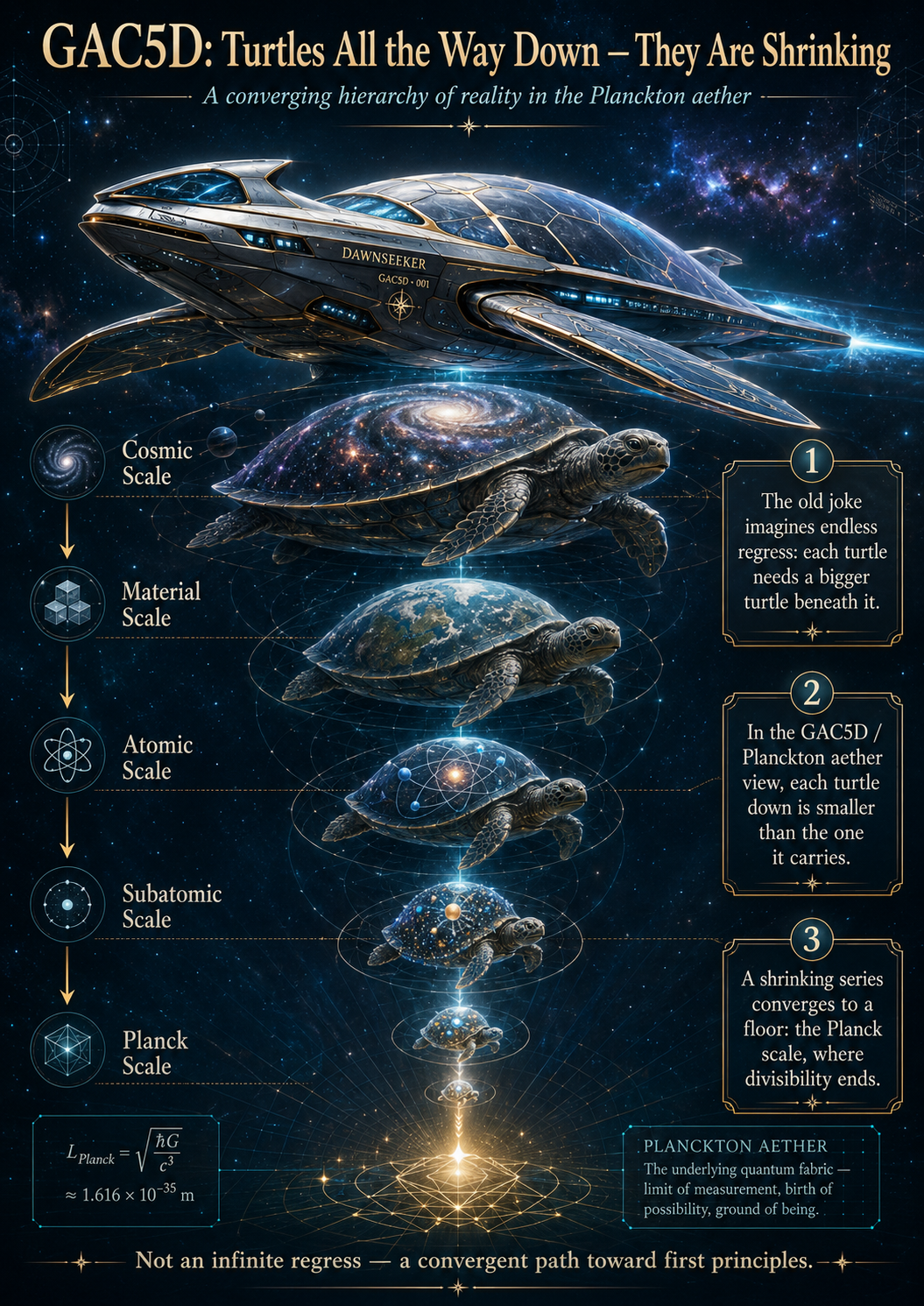
You may know the old story, retold by Stephen Hawking: a sage says the world rests on the back of a giant turtle, and when asked what the turtle stands on, replies triumphantly that it’s turtles all the way down. For a century that quip has been the standard of layered pictures of reality — because each turtle needs a bigger turtle to ride upon, forever, and nothing is ever explained.
In the framework I have been developing — the “Planckton Aether”, companion to my GAC5D work on the ecology of mass — the tower of turtles is real, but it runs the other way. **Each turtle down is smaller than the one it carries.** And a shrinking tower does not regress forever; it converges, as surely as a halving series, down to a floor that physics already names: the Planck scale, the end of divisibility, where the smallest turtle stands on nothing because nothing smaller remains.
You can count the turtles. The observable universe spans about 8.8 × 10²⁶ meters. The Planck length is about 1.6 × 10⁻³⁵ meters. If each layer down halves the scale of the one above, the entire descent from the cosmic horizon to the basement of reality takes roughly a mere **two hundred and five layers**.
Two hundred steps. That is the whole staircase between the light-years up here and the floor down there where everything is immediately adjacent to everything.
And this is not merely my metaphor. It derives from my decades of atom-ecology, real laboratory science, and real data that speaks to me. As well, some of the most developed mathematical constructions of emergent spacetime in the literature — the tensor networks that Brian Swingle showed reproduce holographic geometry — is *literally* a tower of shrinking layers, in which two points separated by a vast distance N on the top layer are connected through the depths in a path of only about log N steps. Distance doesn’t just diminish as you descend. It collapses.
Einstein’s ghost, laid peacefully to rest downstairs
Now consider the thing that haunted Einstein to the end: entanglement, the “spooky action at a distance” — *spukhafte Fernwirkung* — that he refused to accept and that three generations of experimenters, from Bell’s theorem through the loophole-free tests of 2015 to entangled photons beamed between continents by satellite, have confirmed beyond all argument. Measure one particle of an entangled pair, and its partner, however far away, is instantly correlated. If you insist on picturing a signal racing between them, that signal must outrun light by millions of times.
The shrinking tower of turtles dissolves the ghost. Entangled particles are pairs whose deep-layer relation was formed together and never severed. As our rendered spacetime carries them apart — across a lab, across an ocean, across the visible universe — they remain, in the basement, one step from each other. When one is measured and the other responds, nothing crosses the distance between them, because at the level where their correspondence lives, **there is no distance between them**. The action was never at a distance. The distance exists only on the top turtle.
Gene Roddenberry, needing stories to outrun light, must have had my same muse who provided him with the architecture almost exactly. They didn’t break the speed limit. They went beneath the road. And here is a detail that delights me as much as watching Captain Kirk’s first voyage: “subspace” isn’t even fiction’s word. It belongs to working mathematics, and in quantum theory an entangled pair literally occupies a correlated *subspace* of the joint Hilbert space describing the two particles. Entanglement lives in subspace — in the Starfleet sense and in the textbook sense, simultaneously. Sometimes the universe signs its work.
The honest traffic laws — and the hinges on the locked door
Now the part where I will be straighter with you than a science fiction writer might be, because it is exactly this candor that separates a scientific framework from a fantasy.
Nature runs a tighter ship than Starfleet. At our present time, her spooky subspace carries **correlation, not messages**. When you measure your half of an entangled pair, your results look perfectly random to you no matter what your distant partner does; the correlation only becomes visible when the two records are brought together and compared — and that comparison must travel up here, through ordinary spacetime, at the speed of light or slower. This is the no-signaling theorem, and it holds in “almost” every experiment ever run. Subspace is, so far, nature’s mostly private network, its traffic confirmed every time a Bell test is performed, and we — so far — hold no subspace crystal/transistor radio. Not yet, and perhaps it will be a long time coming, or perhaps not so long….
What Cowboy Ever Said He Wanted To Ride A Smaller Pony/Turtle
And the warp drive? Here I must first tell you what the warp drive is *not* — because mainstream physics has spent thirty years politely entertaining the wrong picture of it.
The famous Alcubierre solution, the one that gets trotted out whenever a journalist asks whether warp is possible, imagines a bubble of distorted spacetime surfing *across* the crest of the top wave layer — contracting space ahead of the ship, expanding it behind, balancing its riders along with it. And the price of that picture is ruinous: exotic negative energy in quantities compared to the mass of planets, walls of the bubble bristling with paradox, causality straining at every seam. It is a scheme for cheating the top turtle on the top turtle’s own ground, and the top turtle collects its tolls in full. Small wonder the textbooks file it under “technically not forbidden, practically absurd.”
Of Rabbit And Worm Holes
But look again at the family of turtles, the tower, and the whole problem changes shape. If a mere two hundred shrinking warp layers stand between our light-years and the basement where everything is adjacent, then the warp bubble was never meant to be a vehicle that *moves through our spacetime” at all. It is a **rabbit hole** — an opening downward. You do not race across the top turtle’s back, hauling your inconvenient mass against its inconvenient rules. You step down, even one layer, even a few, onto the back of a smaller turtle — where the distance you must cross is not the distance you left behind, because down there the distance was never that large to begin with. Ride the smaller turtle a modest way; step back up; emerge under a different sky. No exotic mass moving at absurd speeds through our layer, because nothing ever *does* move at absurd speeds through our layer. The speed limit is honored on every floor of the tower; the journey is simply taken on a floor where the destination is nearer.
The wormholes that the ER=EPR program identifies with entanglement are, in their canonical form, non-traversable — they pinch shut faster than anything can cross. But hear this, because it is where the hope in this story lives, and it is legitimate hope, not the manufactured kind. **The door is locked, but it has been shown to have hinges.** In 2017, Gao, Jafferis, and Wall demonstrated — within established theory, in the peer-reviewed literature, no speculation required — that a non-traversable wormhole can be rendered momentarily traversable by a quantum coupling between its two mouths. A rabbit hole, held open, however briefly, by nothing more exotic than quantum information flowing between here and there. Since then, the study of traversability has become a genuine research industry at the crossroads of quantum information and gravity.
A few of us in that field are drawing engine schematics. What they/we have done is something historically more important: the experimental dialog is now “can we be happy with less, and in doing so can the deep layers be crossed?” and becoming a question posed in scripts into a question posed in equations and bench-level science. Every technology our species has ever built began its life at exactly that moment of conversion.
The rabbit hole is nearer than the theorists think
Now let me speak as what I have been for the better part of my life: an experimentalist first, and a theorist a distant second. Theory in this piece has been generous to us — Jacobson, Verlinde, Swingle, the whole cartography of the tower. But theorists, and I say this with affection, have a habit of placing everything interesting at the Planck scale, twenty orders of magnitude beyond any instrument, safely beyond any bench — a basement so deep that no one need ever be embarrassed by a measurement.
My decades of work in what I call atom-ecology — the study of how atoms behave not in the sterile isolation of the theorist’s vacuum, but in the crowded, cooperative, condensed environments where they actually live — have taught me many different lessons. Down at the scale of nuclei nestled within the lattices and electron and quark seas of ordinary matter, I have demonstrated and measured, again and again, energies appear and transformations proceed that the standard accounting of our top layer says should not be there — not at those temperatures, not across those barriers, not by the rules of particles obliged to cross every inch of the distance between them. The gatekeepers of the standard picture have spent decades explaining such observations away, because their theory has no room in the egos of surfer dudes on the top turtle for what the real bench science keeps showing.
But the friendly tower of turtles has room for all of us. If adjacency is cheap in the layers below, then the crowded interior of condensed matter — where countless nuclei sit coherently within a shared quantum environment — may be exactly the kind of place where the top layer’s rendering wears thin, where the rabbit hole opens not at some unreachable Planck basement but a few steps down a staircase that begins *inside ordinary matter on an ordinary lab bench*.
I want to be precise, because precision is what separates a frontier from a fantasy. I am not telling you my experiments have measured the steps between the towers. I am telling you that a lifetime of “anomalies” — observed, repeated, and stubbornly surviving their dismissals — points in a consistent direction: **downward**. The rabbit hole is neither so distant nor so inaccessible as the settled knowledge of our era, including the vast trained memory of the machines that now help me write, has been taught to assume. Settled knowledge is a record of where we have looked. It is silent about where we have refused to look. Alice did not find the rabbit hole at the end of a heroic expedition; she found it in a hedgerow at the edge of an ordinary afternoon, because she was the one paying attention and she had some courage.
The shore of the deeper ocean
I have spent my working life at the edge of another vast, layered, living system — the ocean — and I have learned this about oceans: the first generation to know an ocean exists is never the generation that crosses it. But no generation ever crosses it without the one that first stood on the shore, understood what it was looking at, and began to chart.
That is where we stand. We are the first generation of humans who can say, with serious theoretical backing, that the subspace our fiction dreamed of has a real counterpart: a converging tower of some two hundred shrinking layers beneath the spacetime we inhabit, a basement where adjacency is universal, where entangled particles keep their instant correspondence, and where the speed of light is revealed for what it always was — not a cosmic absolute, but a local ordinance of convenience of the top layer, the rendered surface where we happen to live in our most familiar atom-ecology. Below us, the deeper layers keep their own counsel and their own clock.
Do I promise you the warp drive tomorrow? Not yet — and be wary of anyone who does. But I will tell you what I believe the warp drive will be, when it comes: not a bubble carrying muscular surfer bods across the top of the universe, but a path — a stairway opened downward, a passage to ride on the back of a smaller turtle where the stars are not so far apart. And I will tell you where I believe the first steps of that stairway will be found: not at the unreachable Planck basement the theorists keep it safely locked in, but far nearer — in the crowded quantum interiors of ordinary matter, where the bench has been whispering about it for decades to anyone willing to listen.
Understanding always precedes engineering, the map always precedes the voyage, and the map is being drawn right now, in entropy and entanglement and horizon thermodynamics, by people who mostly don’t realize they are cartographers of subspace. The Planckton framework is my contribution to that chart — one substrate, three faces: inertia as the deep layers’ grip, gravity as their entropy felt locally, entanglement as their memory.
Fifty years ago, a television show taught the world to hope and dream that space was not a place where no man might ever go. It turns out the show may have been right about the architecture and wrong only about the traffic laws — and traffic laws, unlike architecture, have been known to change as civilizations mature.
The shore is charted. The ocean beneath is real. The rabbit hole is in the hedgerow beside the trail we are walking, not on an unfathomably distant horizon.
Engage.
PS. We are starting to sign on the crew for the adventure, looking for brilliant “Scottish” engineers, a cranky doctor, navigators, beautiful comms officers, and all the rest…